
What is a Confidential Information Memorandum (CIM)?
A confidential information memorandum (CIM) is a structured document used in the M&A process to provide potential buyers with a detailed overview of a target company. This document serves as the primary marketing tool during a CIM business sale, offering a narrative that moves beyond simple balance sheets to explain a company's operations, market position, and future potential. For business owners in the lower middle market, the CIM is the bridge between a preliminary "teaser" and a formal Letter of Intent (LOI). It allows qualified buyers to perform an initial valuation and determine if the acquisition aligns with their investment criteria.
How a CIM Works in M&A
A confidential information memorandum (CIM), also known as an offering memorandum, is a deep-dive document prepared by an M&A advisor to market a business to prospective acquirers. Unlike a teaser, which is a one-page anonymous summary, the CIM is only shared after a buyer has signed a Non-Disclosure Agreement (NDA). Its purpose is to answer the most common questions a buyer will have, reducing the friction of the initial due diligence phase.
In the context of CIM in M&A, the document is not merely a data dump. It is a persuasive narrative that frames the company's history, its competitive advantages, and its growth trajectory. A well-constructed CIM helps the seller maintain control of the narrative, ensuring that buyers see the business's potential through the lens of its Value Drivers rather than just historical challenges. At True North Mergers & Acquisitions (TNMA), we treat the CIM as the "prosecution's case" for why a business deserves a premium multiple.

The Role of the CIM in a Business Sale
The CIM business sale process relies on the memorandum to standardize the information flow to multiple parties simultaneously. This creates a "level playing field" where all potential acquirers receive the same data, fostering a competitive environment known as a controlled sales approach. Without a CIM, a seller would be forced to answer the same questions dozens of times, leading to "deal fatigue" and increasing the risk of information leaks.
The memorandum serves three critical functions:
- Professionalism: It signals to the market that the seller is prepared and has professional representation.
- Efficiency: It filters out "tire kickers" by requiring a significant time investment from the buyer to review the 30-to-60-page document.
- Valuation Anchor: By highlighting specific Growth Opportunities, the CIM justifies the asking price or the expected valuation range.
Key Components of a CIM
A professional confidential information memorandum follows a logical structure that anticipates a buyer's psychological journey from curiosity to commitment. While the specific details vary by industry, the following sections are standard.
Executive Summary
The executive summary provides a high-level overview of the investment thesis. It highlights the "why" behind the sale and the "why" behind the purchase. This section focuses on the company’s core mission, its primary Value Drivers, and a snapshot of its financial performance.
Company Overview and History
This section details the origin of the business, its ownership structure, and its evolution. Buyers look for stability and a clear reason for the company's current market position. If the owner is planning an internal exit or a sale to an external party, the history provides the context for that transition.
Product and Service Lines
Here, the CIM describes exactly what the company sells and how it generates revenue. It includes information on intellectual property, proprietary processes, and the lifecycle of the primary offerings.
Market and Industry Analysis
Buyers need to know the size of the "pond" the company is swimming in. This section uses third-party data to validate the industry's health and the company's share of that market. It identifies competitors and explains the company’s "moat" or competitive advantage. The use of an offering memorandum in M&A transactions helps standardize how buyers evaluate these market conditions and investment opportunities.
Operational Infrastructure
This includes details on the management team, employee base, facilities, and technology systems. A key focus here is the company’s corporate culture and whether the business can function without the current owner—a critical factor in lower middle market valuations.
Financial Performance and Adjusted EBITDA
This is the most scrutinized section. It provides three to five years of historical financial statements and, crucially, the adjusted EBITDA (Earnings Before Interest, Taxes, Depreciation, and Amortization). Adjustments, or "add-backs," are used to show the true earning power of the business under new ownership.
How TNMA Crafts a CIM to Maximize Value
At True North Mergers & Acquisitions, we believe that what CIM is depends entirely on who is reading it. A CIM written for a financial buyer (like a private equity group) looks very different from one written for a strategic buyer (a competitor or a company in a related industry). Our approach focuses on identifying and highlighting Financial Synergies that a buyer can realize post-acquisition.
We go beyond historical data to uncover "Information Gain" for the buyer. This involves:
- Highlighting Strategic Synergies: We identify how your company’s specific assets—like a specialized sales force or a unique distribution network—can help a buyer reduce costs or increase revenue in their existing operations.
- Quantifying Growth Opportunities: We don't just say there is "room to grow." We provide data-backed roadmaps for geographic expansion, new product lines, or untapped customer segments.
- Pre-empting Due Diligence: By conducting a sell-side quality of earnings review before writing the CIM, we address potential "skeletons in the closet" proactively.
Our goal is to ensure the CIM triggers a "must-have" response from the right buyer, which is essential for achieving the best net after-tax proceeds for the seller.

Who Receives the CIM?
The distribution of a confidential information memorandum is a highly controlled phase of the sell-side M&A process. It is never sent to a broad list of prospects. Instead, it is reserved for a curated group of "qualified buyers" who have cleared a three-step vetting process.
- The Teaser: Prospective buyers receive a "blind" summary that does not name the company.
- The NDA: If the buyer is interested, they must sign a legally binding Non-Disclosure Agreement.
- Financial Vetting: TNMA confirms the buyer has the financial capacity and the strategic intent to complete a transaction of this size.
Only after these steps is the CIM released. Recipients typically include private equity groups, strategic corporate buyers, and occasionally high-net-worth individual investors or family offices.
CIM vs. Teaser vs. Offering Memorandum: Understanding the Differences
The terminology in M&A can be confusing. While what CIM is our primary focus, it is often used interchangeably with other terms.
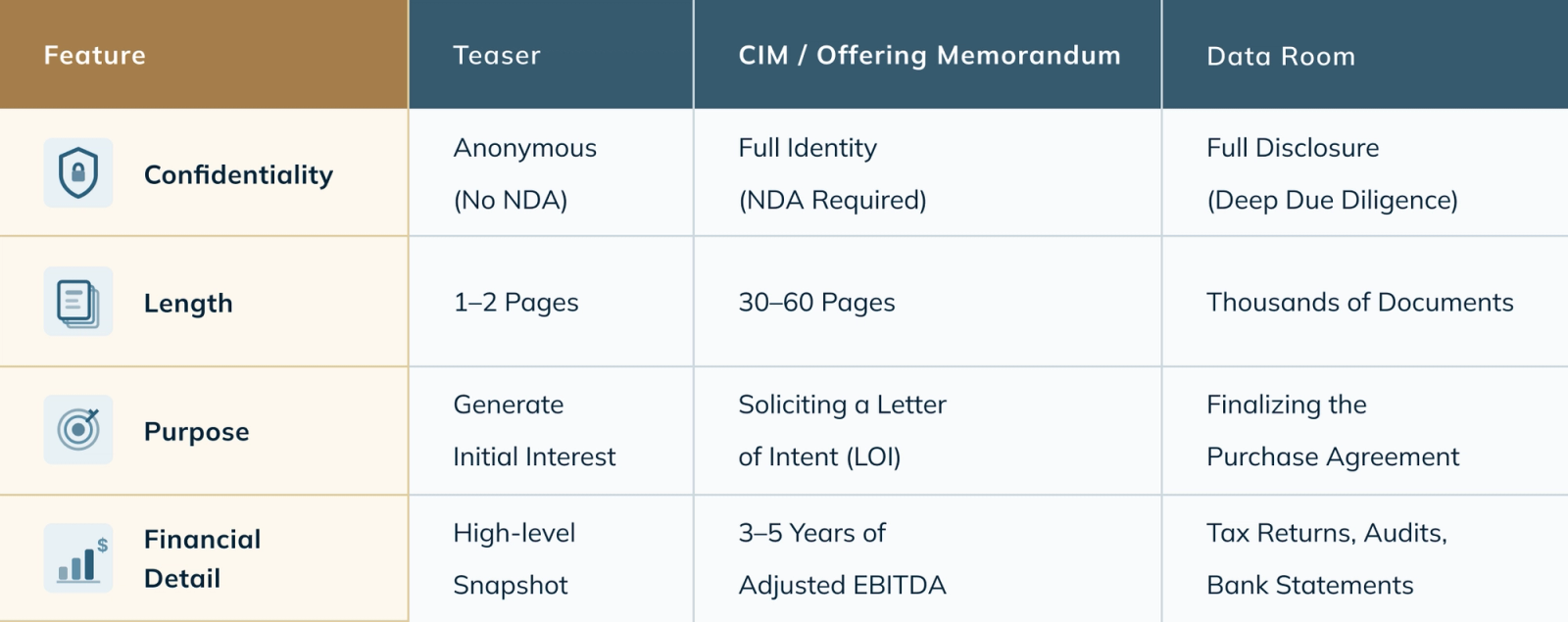
In some industries, particularly real estate or late-stage startups, the term offering memorandum is more common, but in middle-market M&A, "CIM" is the standard. Regardless of the name, the goal remains the same: provide enough information to secure a business price opinion or a formal offer without compromising the day-to-day operations of the business.
Frequently Asked Questions
What is included in a CIM?
How does a CIM tell my company's story?
Who receives the CIM?
Does every business sale need a CIM?
Preparing Your Business for the Market
Let our elite team of advisors guide you towards a better solution for your financial future.








It’s Our Culture That Makes Us Different


We Take Action
Our professional advisors bring perseverance, problem-solving, and a “get it done” attitude to the table.


Our Team Works Hard & Plays Hard
We balance a strong work ethic that brings profitable results to our clients within a culture that celebrates the process.

We’re Leaders In More Ways Than One
At True North Mergers & Acquisitions, we’re a leader to our clients, a leader in the marketplace, and leaders to each other.

We Believe in Teamwork
We bring our whole selves and work as a team to deliver world-class service to our clients.

Help People First & Success Will Follow
We’re devoted to encouraging, equipping, collaborating and uplifting all who come in contact with us.


It’s All About Servant Leadership
This is the core purpose of why we exist — placing the needs of others before ourselves. Success will follow.




Our Advisors Bring You Expertise, Market Knowledge & Industry Contacts
Meet the people of True North Mergers & Acquisitions — a team of high-caliber advisors and industry experts who will rally for you.


Dan Sundin
Tim, you did a fantastic job from start to finish, explaining the process, exercising patience and good judgment as needed, teaching, and guiding us all the way. I watched in awe as you gave counsel to us as well as the potential buyers – working your magic to create excitement on both sides for the potential we’re realizing today – thank you!
Clay, you impressed from the first meeting – you won me over quickly with your professional demeanor, presence, and ability. Your work ethic was evident as you plowed through our data and reached out to me evenings and weekends, ensuring the numbers and our true financial opportunity unfolded accurately and enticingly to our prospective buyers.


$10M - $250M
TYPICAL TRANSACTION SIZE
30+ M&A
PROFESSIONALS
$4B+
TRANSACTIONS CLOSED
What Our Clients Say About Partnering With Us
Our advisors’ decades of experience, market knowledge, and industry expertise have proved invaluable to our clients. Here’s what they say about working with the True North Mergers & Acquisitions team.